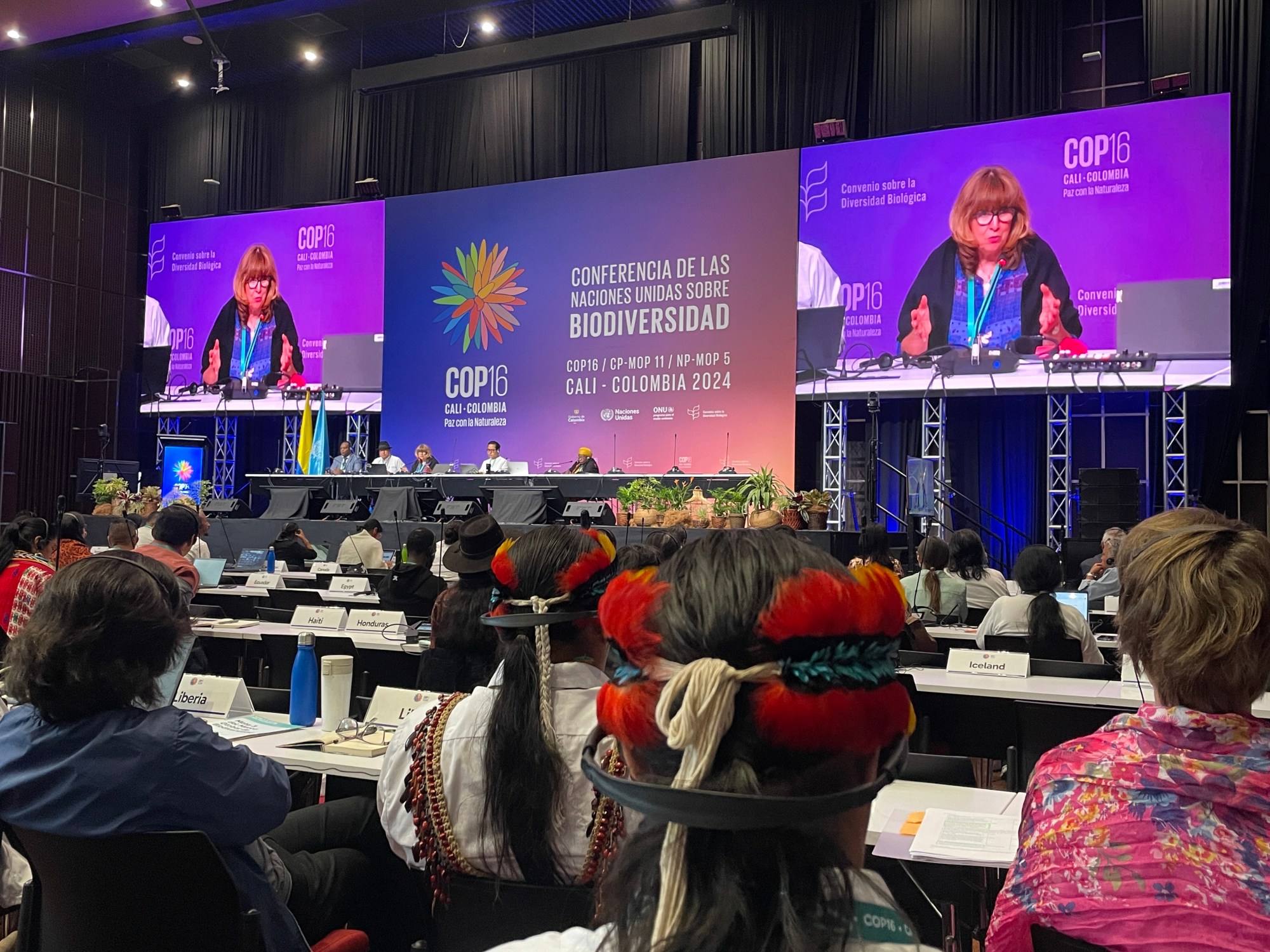
Manu Caddie is a member of the inaugural Steering Committee for the Multilateral Mechanism for the Fair and Equitable Sharing of Benefits from the Use of Digital Sequence Information on Genetic Resources, including the Cali Fund, representing Indigenous Peoples and local communities in the Pacific region. In this article he discusses a recent critique of a study commissioned by the Secretariat of the Convention on Biological Diversity (CBD) designed to examine possible ways – including new or modified databases – to make more DSI openly available while also improving transparency and accountability.
Our Steering Committee colleague Nithin Ramakrishnan from Third World Network (TWN) has published a critique of a recent study commissioned under the CBD on “tools and models, such as databases, for making digital sequence information on genetic resources publicly available and accessible in a transparent and accountable manner.” The call from a number of countries and groups for an independent review of the report does seem justified. The study had resourcing constraints and no doubt prescribed fairly heavily by the CBD Secretariat, so the consultation process was subsequently limited and uneven, its feasibility methodology wasn’t fully developed, and some of its conclusions are expressed with more confidence than the supporting evidence seems to justify.
But I think TWN’s critique also goes a bit too far. It sometimes presents inadequate analysis as total omission, it overlooks evidence that complicates its argument, and treats legitimate scientific and operational concerns as if they only reflect vested interests. I also think its allegations of bias and conflict of interest are also way stronger than the evidence seems to support.
The result is a critique that identifies real weaknesses but does not itself provide the kind of balanced assessment it is demanding from the study.
The report’s limitations are real
The most persuasive part of TWN’s critique concerns the study’s methodology. The report drew on submissions from Parties and observers, around 40 informal interviews (full disclosure, I think I was one of the interviewees and I’m also at the Genomic Standards Consortium conference with the report author this week), an academic survey with 152 respondents, and a private-sector survey with only nine respondents. The interviews included governments, representatives of Indigenous Peoples and local communities, academics, database managers, and industry representatives. This was broader than TWN sometimes suggests, but it was not globally representative.
Europe, North America, and Oceania were substantially overrepresented in the interviews, while Africa and Asia were underrepresented, and the report’s author explicitly acknowledges this. The report transparently discloses that the consultations were English-only, that interviews were not recorded, and that questions were tailored to match the participants’ expertise. It acknowledges the participation problem caused by English-only consultation, but probably doesn’t examine the reliability, comparability, and potential interviewer-bias implications of the other two methodological choices enough. In a perfect world those issues could all be addressed in the method, but with limited resources, the risks attached to those methodological challenges probably did need to be teased out a bit further by the author and/or CBD Secretariat.
The separate surveys also concentrated on academia and the private sector. There was no equivalent survey of provider-country authorities, data submitters, Indigenous Peoples, or local communities. Although those groups participated in interviews and submissions, the design produced a more substantial quantitative account of the views of existing database users than of the people and institutions seeking greater accountability from those databases.
This matters because the report relies heavily on stakeholder perceptions when assessing whether proposals are feasible. Resistance from researchers or database operators can be relevant to implementation, but it should not be treated as neutral evidence of whether reform is desirable, lawful, or technically achievable.
TWN and the countries and groups calling for a peer review are right to argue that the evidence base cannot sustain firm policy conclusions without further scrutiny and validation.
My suspicion is that these and other shortcomings in both the methodology and lack of independent review outside of the Secretariat, were constraints imposed by the scope of the contract rather than inadvertent or deliberate omissions by the author.
The feasibility assessment is too opaque
The study’s most consequential conclusion is probably that the advantages of new database infrastructure are “consistently outweighed” by cost, complexity, duplication, fragmentation, interoperability problems, and risks of reduced access and use. That is a strong comparative judgment. And the report doesn’t seem to disclose a sufficiently rigorous method for reaching it.
Its summary assessment considers advantages, disadvantages, technical and legal difficulty, financial burden, and the need for cooperation from existing databases. Again, I doubt it was possible with the time and resources available, but the study doesn’t provide a transparent weighting system, detailed cost models, implementation scenarios, sensitivity analysis, or measurable thresholds for what would be considered success. Nor does it consistently evaluate each option against the same accountability criteria.
This creates a bit of structural imbalance – the report counts the costs and risks of reform (new infrastructure, user friction, duplication, and reduced scientific uptake, etc.) but doesn’t apply an equivalent analysis to the costs of retaining the existing system. Those costs may include unverifiable legal compliance, limited provider participation in governance, incomplete provenance information, weak tracking of downstream use, and an unequal distribution of scientific and economic benefits. These are very real risks and costs for IP&LC communities to carry, that needed more weight in the analysis.
An assessment that measures the disruption caused by change without similarly measuring the harms of the status quo will tend to favour incrementalism. I think TWN is subsequently justified in drawing attention to that risk.
I’d suggest that the appropriate conclusion, however, is that the report’s ranking of these costs and benefits to various stakeholders is insufficiently demonstrated – not that every concern about new infrastructure is invalid.
Accountability to Parties needed clearer treatment
Decision 16/2 provides important context for the study. Paragraph 4 calls for exploration of tools and models for making DSI publicly available and accessible in a transparent and accountable manner “to all Parties.” Paragraph 6(b), which directly commissions the study, uses similar language but omits the final words “to all Parties.”
The study naturally follows the wording of paragraph 6(b). TWN is nevertheless probably right that the decision should be read as a whole. Accountability to Parties is not an incidental phrase, it has been a key concern about who governs DSI infrastructure, whose laws and interests it recognises, and whether provider countries and communities can meaningfully scrutinise how information derived from their genetic resources is submitted and used.
The report identifies geographical inequalities in database ownership and governance, and it proposes governance mechanisms involving Parties. But it never really defines what being “accountable to all Parties” would require in practice. Nor does it use that requirement as an explicit criterion throughout its comparison of options.
That seems to be an important omission in the analytical framework. It does not follow, however, that the study completely misunderstood its mandate. Its stated objective closely reflects the specific commissioning language in paragraph 6(b), and much of the report addresses transparency, governance, sovereignty, and legal certainty. The problem seems to be again, an incomplete assessment rather than no adherence to the study mandate.
TWN understates the report’s treatment of lawful submission
TWN argues that the study fails to evaluate proposed tools against the provision in the annex to Decision 16/2 that the multilateral mechanism covers DSI made publicly available in compliance with applicable national legislation.
This criticism identifies an important weakness but I think overstates it.
The study explicitly discusses the national compliance requirement. It examines the absence of permit information in major databases, recognises that current arrangements cannot guarantee compliance with ABS obligations, and considers permit databases, mandatory registration, metadata improvements, licensing tools, and legal contracts. It also observes that publicly available DSI within the mechanism should either require no ABS permit or be covered by a permit allowing it to be shared without access or use restrictions.
The report therefore did not ignore lawful submission.
The stronger criticism is that it failed to make verifiable compliance a consistent test for every proposal. Informing submitters of their legal obligations is not the same as verifying their authority to upload information. A voluntary declaration isn’t necessarily evidence of compliance. Website analytics and educational tools may increase awareness and transparency, but they don’t deal with the underlying problem of determining whether DSI entered the system lawfully.
TWN is right about the unresolved gap, but I think it’s wrong to imply that the report never recognised it.
The report does propose accountability mechanisms
TWN also suggests that the study’s conclusions fail to explain how transparency and accountability could actually be achieved. However the report includes reference to numerous relevant mechanisms, including:
- permit and rights metadata
- mandatory registration
- a permit-monitoring database
- website analytics
- tracking of academic publications and patents
- legal contracts and licensing tools
- country-of-origin and Traditional Knowledge metadata
- governance arrangements connecting Parties and database operators
- monitoring implementation of the CARE principles
- greater participation by Indigenous Peoples and local communities
These proposals vary greatly in effectiveness and maturity. Some would provide little more than education or visibility but others could create more meaningful traceability and accountability. The report doesn’t integrate these options into a coherent model or demonstrate that its preferred combination would satisfy the decision’s objectives.
It’s therefore fair to say that the report doesn’t provide a robust accountability solution, but I don’t think it’s fair to say that it offers none.
The cost comparison deserves scrutiny, but not dismissal
TWN questioning the report’s treatment of the cost of a new database seems fair.
The report considers a “full DSI database” with functionality comparable to the existing global network and uses the INSDC as a proxy, suggesting an annual operating cost of approximately US$50 million. It compares that figure with the CBD Secretariat’s budget and suggests that operating such a database through the Secretariat could require the budget to at least double.
This comparison creates an impression that an accountable alternative would necessarily involve reconstructing an enormous global infrastructure under the CBD. But the report doesn’t demonstrate that this is the only – or even the most plausible – model. An accountable system could take the form of a federated network, an accreditation regime, a compliance and provenance layer, a permit registry, a trusted research environment, or a service agreement with one or more existing repositories.
TWN is therefore right to expect more realistic implementation scenarios and better disaggregated costs.
At the same time, the TWN response kind of changes the proposal being evaluated. The study’s “full database” scenario is expressly defined as a large system replicating existing functionality. For that scenario, existing global infrastructure is a relevant, if imperfect, cost benchmark. The study also considers smaller alternatives, including a “valuable DSI” database and a permit database.
So I’d say the cost analysis is crude and probably overstated, but not wholly inaccurate or irrelevant.
Scientific adoption is a real concern, not just an incumbent interest
I think one of the weaknesses in TWN’s critique is its treatment of scientific and technical objections. It tends to interpret all concerns about interoperability, fragmentation, researcher uptake, and administrative burden as manifestations of institutional self-interest.
Such interests certainly exist, they’ve already been expressed on day one of the Genomic Standards Consortium global conference we’re attending this week. Existing database operators and researchers have professional incentives to preserve familiar systems and I’d suggest there is a degree of ignorance and arrogance in some attitudes. But many of the concerns are still pretty legitimate.
DSI research often depends on combining vast quantities of standardised information. A new repository that is poorly integrated with existing databases would likely fragment datasets, create conflicting records, increase curation burdens, and be ignored by journals or researchers. Compliance requirements that are unclear, duplicative, or impossible for individual researchers to adhere to would probably discourage lawful data submission without improving benefit sharing.
None of this proves that stronger accountability is undesirable. It just means accountability measures must be designed to preserve interoperability and remain usable. A balanced analysis needs to evaluate both sides of that problem.
TWN’s critique could be stronger if it acknowledged these risks and showed how its preferred models could address them.
“Open” should not automatically mean anonymous and unconditional
I do think TWN raises a useful conceptual challenge to the report’s apparent treatment of open access.
Public accessibility need not require anonymous access, absence of audit trails, or freedom from all procedural conditions – this was discussed at the GSC conference today. A resource can remain broadly accessible while requiring registration, acceptance of standard terms, preservation of provenance information, or additional safeguards for sensitive data and associated Traditional Knowledge.
Decision 16/2 itself combines support for open access with expectations concerning CARE, TRUST, national and international ABS obligations, country-of-origin information, traditional knowledge, and restrictions on sharing. This suggests that openness needs to be understood alongside responsibility, rights and lawful governance.
The report recognises a lot of this complexity, but its emphasis on “friction” risks treating accountability requirements principally as obstacles to scientific use. I think it could benefit from more clearly distinguishing restrictions that improperly impede research from proportionate measures that make access traceable, lawful, and accountable to rights holders.
TWN’s criticism is important here, although I don’t think its suggestion that incumbent databases and associated policies facilitate “digital biopiracy” is entirely accurate or helpful in this context – though at least it got my attention!
Provider interests deserve greater attention
The report tends to frame database users mainly as those who search, download, and analyse DSI. It gives less systematic attention to providers and submitters as users of database services in their own right. This is another useful point made by TWN.
Provider countries, Indigenous Peoples, local communities, and originating researchers may reasonably want systems that help them:
- establish the lawful basis for submission
- receive notice of relevant downstream uses
- identify potential research partners
- communicate standardised collaboration offers
- track non-monetary benefits
- protect associated Traditional Knowledge
- exercise collective and shared rights and responsibilities
- correct or challenge improperly uploaded information.
From the perspective of a downstream researcher, these functions may look like additional friction. From the perspective of a provider, they may constitute the substance of accountability and equitable participation.
TWN is right to say that the study does not bring these functions together into a convincing provider-oriented model. The report’s catalogue of individual tools is useful, but it lacks a coherent account of how an accountable database system would serve providers, submitters, users, and Parties simultaneously.
Conflict of interest claims aren’t justified
The report’s failure to identify its consultant and disclose relevant institutional affiliations is a legitimate transparency concern. Readers should be able to assess the expertise, perspective, and potential conflicts of those responsible for an influential policy study. My understanding is the author would be happy to be identified with the document, it’s a bit odd the Secretariat has chosen not to do so, at least to date.
That concern doesn’t, by itself, establish a conflict of interest.
TWN reports that unnamed sources identified the consultant as a member of a scientific stakeholder network associated with a particular view of open access. Without public documentation of the person’s identity, role, affiliations, financial interests, and influence over the conclusions, this remains an unfounded allegation rather than a demonstrated conflict. It also doesn’t prove the individual subscribes to the supposed view of the particular network, my understanding is that in fact they have been supported to participate in a range of CBD events by organisation with very strong Indigenous data sovereignty positions.
It is also necessary to distinguish between holding a substantive policy position and having a disqualifying conflict. Researchers, advocates, officials, Indigenous representatives, database operators, and industry participants may all have established views and institutional interests. The appropriate position is transparent disclosure, methodological safeguards, plural participation, and independent scrutiny – not an assumption that expertise or prior engagement necessarily invalidates a person’s work.
TWN might be right to raise the question, but it’s not justified to suggest the answer as already known.
Independent review is the sensible response
The study should not be dismissed. It provides a substantial description of the DSI database landscape, candidly reports several limitations, identifies important governance gaps, and catalogues a wide range of possible tools. Its discussion of Indigenous data governance, metadata, legal uncertainty, geographical inequality, and existing database practices gives Parties useful material for further consideration.
But neither should its conclusions be treated as settled findings. As noted, the study’s consultation base wasn’t balanced, its feasibility method doesn’t seem consistent, and its preference for incremental solutions appears at least partly influenced by the criteria it selected. It doesn’t adequately demonstrate how its preferred tools would deliver real accountability to Parties, let alone Indigenous Peoples and local communities, or verify compliance with applicable national legislation, where it exists.
Before the study informs major policy choices, I agree that it should be subjected to independent scientific, legal, technical, and economic review. Parties, Indigenous peoples and local communities, provider-country institutions, database operators, researchers, and other relevant stakeholders should have a structured opportunity to comment. Ideally alternative implementation models should also be costed and assessed against common criteria, and more input solicited from more diverse stakeholders.
The criteria should include not only cost, interoperability, and scientific uptake, but also lawful submission, accountability to Parties, provider participation, legal certainty, Indigenous rights, benefit sharing, accessibility, privacy, and the distribution of governance power.
But that process shouldn’t be drawn out and the author and Secretariat should have the opportunity to take on board the feedback and provide further comments or a final report.
Conclusion
Third World Network has performed a useful service by challenging the confidence of the report’s conclusions and insisting that accountability cannot be reduced to education, voluntary metadata, or the preferences of existing database users. Its concerns about representativeness, methodological transparency, compliance verification, provider interests, cost assumptions, and the absence of external review deserve serious consideration and additional resourcing to rectify.
But TWN weakened its case when it said the report ignored matters it plainly discusses, discounted legitimate operational risks, attributed conclusions primarily to vested interests, or treated an undisclosed possible affiliation as evidence of an actual conflict. Advocacy for equity and accountability doesn’t mean critics can misrepresent the facts, to be taken seriously and create positive change, we need accurate assessments and good evidence from all quarters.
The fairest assessment seems to me to lie somewhere between wholesale acceptance and wholesale rejection. The study is a useful but methodologically limited starting point. TWN’s critique identifies important reasons not to rely on it uncritically, but the critique itself should also be read critically. What is needed now is not a contest between open science and accountability, but a better-designed analysis of how both can be achieved together.
 Aotearoa Indigenous Rights Trust