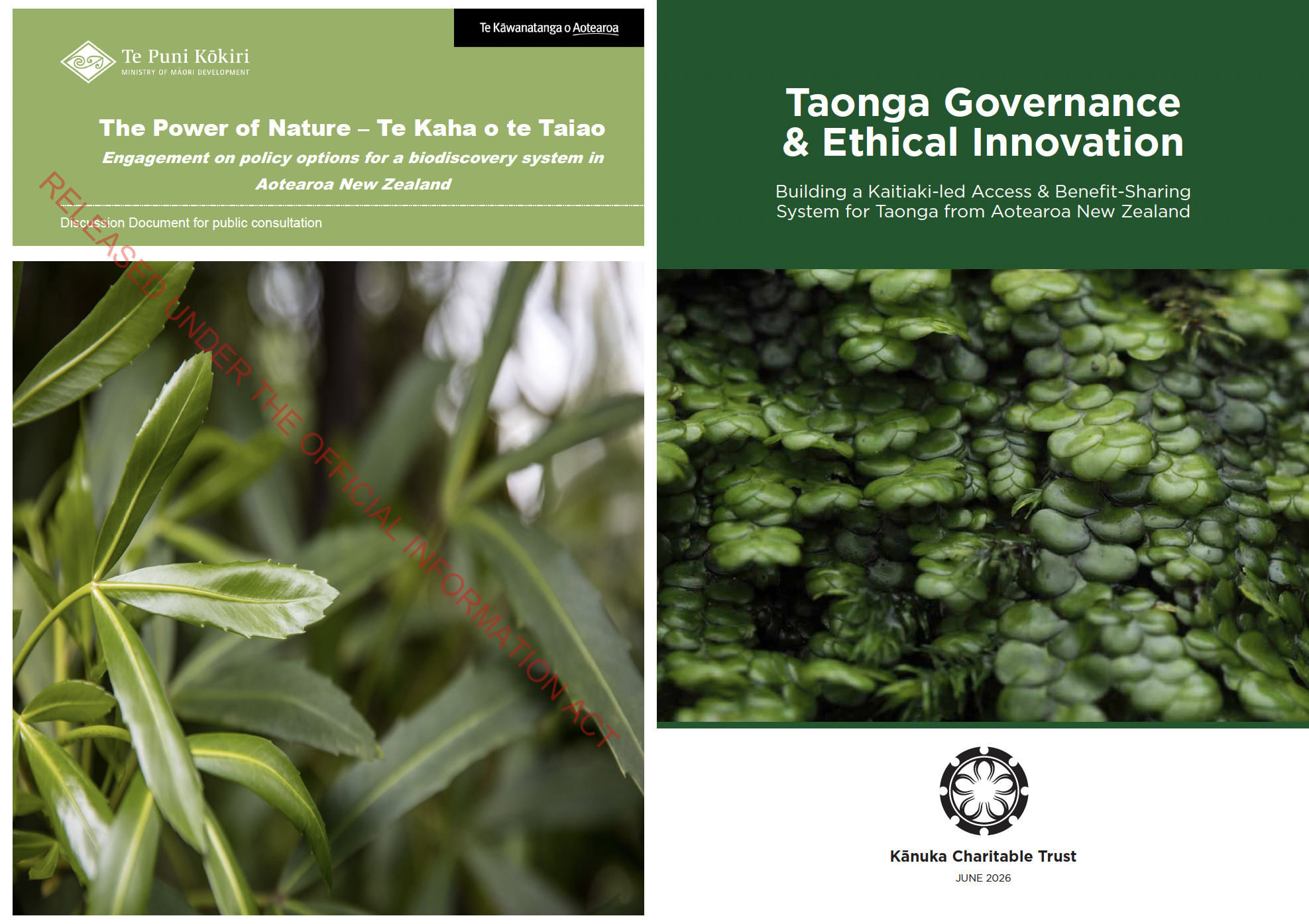
Manu Caddie is a policy advisor for Aotearoa Indigenous Rights Trust and submitted this piece for publication to celebrate release of a government document that was politically too hot for the Coalition Government.
After months of trying, bring denied initially, challenging the official decision and going through the Office of the Ombudsman to request a review of the grounds for TPK denying release, we’ve finally received documents that show what happened to the Government’s proposed Biodiscovery Discussion Document.
During 2024 and 2025, the team led by the awesome Laine Fisher at Te Puni Kōkiri worked with iwi and hapū representatives, Māori businesses and landowners, researchers, science organisations, kaitiaki collectives, rongoā practitioners and government agencies to develop a detailed proposal for a national biodiscovery system.
The 67-page Discussion Document was meant to start a public conversation about some big questions such as:
- What permissions should be in place for businesses and researchers interested in utilising indigenous organisms?
- How should the rights and interests of kaitiaki be recognised?
- How should risks and benefits be managed?
- And how should mātauranga Māori be protected from misuse?
In good faith, the officials involved took all the feedback and proposed clearer access and benefit-sharing rules, recognition of kaitiaki relationships, more robust commercial pathways that would have real integrity, patent disclosure requirements and possible certification for ethically developed products.
Their advice to the Minister and recommendations in the Discussion Document were pretty clear – the current system is fragmented, creates uncertainty for Māori, researchers and businesses, and risks leaving Aotearoa behind internationally.
In July 2025, Minister for Māori Development Tama Potaka allowed officials to continue developing the proposal. He asked them to simplify the message, include stronger case studies and emphasise New Zealand’s untapped economic potential.
The plan was to take the Discussion Document to Cabinet, consult publicly, and then develop final policy recommendations.
But the public never got to see it. In November, the Minister was given a choice to continue developing the complete framework and consult through the Discussion Document, or pursue a much narrower set of measures. He chose the narrow option.
The Discussion Document did not go to Cabinet. Probably because he knew some of his Cabinet colleagues would never support it and the Discussion Document could go the same way as the ill-fated He Puapua report on implementing the UN Declaration on the Rights of Indigenous Peoples after it got weaponised by the National and ACT parties in 2021.
There’s a real risk that this document could be similarly co-opted by the right wing zealots who can’t stand the idea of Māori having special rights and responsibilities as tangata whenua. Of course in this case, it was commissioned and under the direct control of a National minister, so hopefully that makes some difference and the HP idiots find better things to waste their time and political capital on.
In any event, public consultation was cancelled and by July 2026, Te Puni Kōkiri said the wider programme had concluded and the work was considered complete.
I find it all deeply disappointing, but not a waste of effort. A great deal of thought went into this work. More importantly, it dealt with complex issues around taonga governance, mātauranga Māori, kaitiakitanga and who benefits when indigenous organisms are commercialised. Those questions have not gone away simply because the policy process was put on hold.
And whether or not the next administration picks up the rākau to progress this kaupapa, we now have access to a very useful collation of ideas and options that Māori and everyone else can carefully consider, deliberate on sensibly and design a system that looks after the taonga entrusted to each generation, supports ethical utilisation where it can be done properly and creates opportunities for all of Aotearoa and beyond, by leading the world on issues around access and benefit-sharing that are raging hot around the world, particularly in negotiations like the Pathogen Access and Benefit-Sharing (PABS) system being debated under the World Health Organization’s Pandemic Agreement, the Antarctic Rights campaign, and the Biodiversity Beyond National Jurisdictions (BBNJ) or High Seas Treaty that New Zealand signed in 2023 to protect open ocean areas outside national borders.
Through the Kānuka Charitable Trust (KCT), we recently published our own report on these issues as part of a two year project with support from MBIE. Entitled ‘Taonga governance & ethical innovation: Building a kaitiaki-led access & benefit-sharing system for taonga from Aotearoa New Zealand’, it’s available for downloading via the University of Waikato website here.
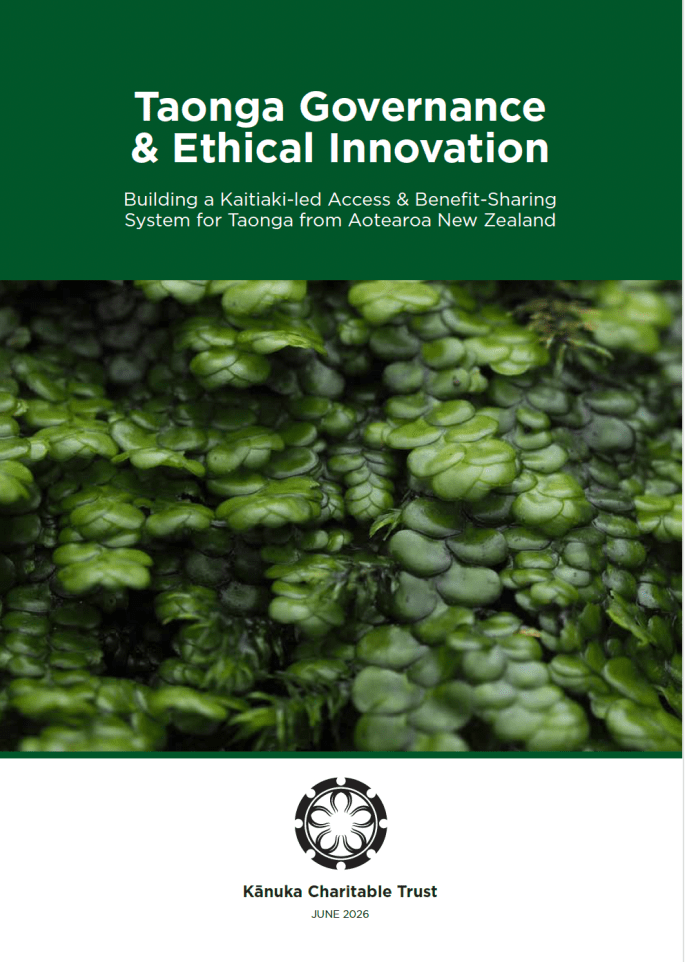
This project began as an investigation into the implications of the Nagoya Protocol and related international frameworks for Māori ownership, access and benefit-sharing (ABS) in relation to indigenous organisms in Aotearoa New Zealand. It evolved into a broader exploration of Indigenous governance, taonga species coordination, ethical commercialisation systems, mechanisms for exercising shared rangatiratanga rights and responsibilities, and the practical infrastructure required to support Treaty-consistent biodiscovery in Aotearoa.
In addition to navigating the commonly understood regulatory vacuum leaving taonga and kaitiaki rights unprotected, the KCT report identifies two fundamental gaps in Aotearoa’s emerging biodiscovery system that were only lightly touched on in the Biodiscovery Framework Discussion Document produced by Te Puni Kōkiri. The first is the absence of practical mechanisms through which kaitiaki can exercise shared rights and responsibilities in relation to taonga species, ecosystems, mātauranga Māori and innovation. The second is the absence of institutions capable of representing the interests of taonga themselves within research, investment, commercialisation and governance arrangements.
The work occurred during a period of major national transition. During the life of the project, the Government committed NZ$42.8 million toward a Biodiscovery Platform to be led by the Bioeconomy Science Institute (BSI). This combination of significant investment in biodiscovery infrastructure alongside a stalled regulatory framework creates a policy contradiction and defines the challenge addressed by the KCT report.
Aotearoa is at a genuine inflection point. While the absence of a legislated ABS regime remains a critical gap, the larger opportunity identified in this report is the creation of practical mechanisms through which Indigenous communities can exercise shared rights and responsibilities, and through which the interests of taonga can be represented within innovation systems. The emergence of taonga governance entities like the Kānuka Charitable Trust, Mānuka Charitable Trust and the Wairuakohu Charitable Trust, or Te Pūnaha Taonga, the new platform we’re building for shared taonga governance, and the new Biodiscovery Platform collectively could create a unique opportunity to build governance arrangements, Indigenous-led conservation and ethical commercialisation systems unlike any currently operating elsewhere in the world.
Whether the outcome of these apparent contractions is a coherent, Treaty-consistent biodiscovery system that provides for the interests of both people and taonga, or a fragmented and partial one, will depend on decisions made now and going forward about taonga governance architecture, legislative foundations and constitutional arrangements, the exercise of kaitiaki authority, commercial structures, capability investment and accountability.
If anyone wants a copy of the Biodiscovery Framework Discussion Document almost released for public consultation by Te Puni Kōkiri, let me know (manucaddie[at]gmail.com) and I’ll send it to you.
 Aotearoa Indigenous Rights Trust