
The rights of Indigenous Peoples in relation to Digital Sequence Information (DSI) is an issue that has been under discussion in the United Nations Convention on Biological Diversity (CBD) for some years. Representatives from Aotearoa Indigenous Rights have been working with other Indigenous Peoples and experts on this topic at both domestic and international levels.
What is DSI?
DSI is a term with no internationally agreed definition but is used by the CBD to describe electronically stored and exchanged DNA sequence information (a computerised representation of genetic information). DSI is widely used for the conservation and sustainable use of biodiversity. The use of DSI provides significant benefits globally, including in conservation (e.g. ecosystem research), science, agriculture (e.g. supporting breeding of plants and animals) and public health (e.g. developing vaccines and medicines). More information on DSI is available on CBD website, here: https://www.cbd.int/dsi-gr/.
DSI negotiations within the CBD
Discussions of options to address DSI have been progressing in the CBD. While there seems to be convergence between international parties to the CBD on the need for fair and equitable access to and sharing of the benefits arising from the use of DSI, there is currently no agreement on how to do this. International negotiators, including AIR Trust representative Katie Lee Riddle, have been discussing this at successive global conferences of state parties (including Indigenous Peoples representatives) and associated working group meetings over many years.
DSI negotiations within WIPO
DSI has also been the subject of much discussion in meetings of the World Intellectual Property Organisation – a United Nations body responsible for agreements about Intellectual Property (IP). A new global Treaty on Genetic Resources and Associated Traditional Knowledge was negotiated over 20 years and finalised in 2024. This Treaty covers the use of genetic resources and associated traditional knowledge in patents but it did not include reference to DSI. This matter remains outstanding and will need to be progressed ahead of a review of the Treaty that is due in 2028.
What DSI means for Aotearoa
The management of DSI has important implications for countries like Aotearoa, when genetic resources and/or associated traditional knowledge of indigenous communities are accessed and utilised. For example, in Peru the gene bank of the International Potato Centre has genotyped its entire collection and has also been operating to give back sweet potatoes cultivars to indigenous communities. The opportunities and risks are strongly linked to Te Pae Tawhiti (the all of government response to Wai 262), concerning the protection of kaitiaki interests in taonga species and mātauranga Māori.
For this reason the New Zealand government has committed to ensure any outcome of the international negotiations keeps open domestic policy options to address DSI in our local context.
AIR Trust position on DSI negotiations
AIR Trust has prepared the following statement on DSI:
AIR Trust supports the Principles for Benefit Sharing as outlined in the Te Kotahi Research Institute Infosheet ‘Evolving Benefit Sharing Regimes – A Way Forward’ (Brooks et al, 2024).
Support the sustainability of taonga – Funding should prioritise the protection of biodiversity and mātauranga.
Make visible relationships with taonga – Provenance information for iwi, hapū and kaitiaki should be recorded and displayed
Promote direct relationships with iwi, hapū, whānau, and kaitiaki – Bilateral agreements and relationships should be encouraged where possible
Recognise monetary and non-monetary benefits – To both first movers and the wider kaitiaki community
Recognise multiple interests – Benefits shared with first movers as well as the broader kaitiaki community
Ensure benefit-sharing from use of taonga – Develop multilateral mechanisms and ensure pathways for benefits within challenging contexts
Recognise rangatiratanga and rights to taonga – Māori governance of and within multilateral mechanisms
Moving up the benefit chain – Create opportunities for Māori to benefit across all parts of the value chain
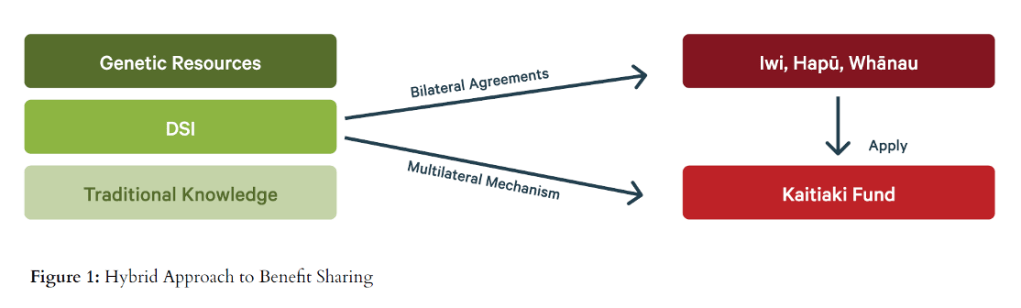
AIR Trust sees value in using the approaches prescribed within the Nagoya Protocol as well as the multilateral mechanism to increase access and benefit sharing with Māori and Indigenous communities. Using a hybrid approach to benefit sharing, it is possible to harness the benefits of access and benefit sharing (ABS) systems within the Nagoya Protocol as well as the proposed multilateral mechanism in the CBD.
Figure 1 outlines this hybrid approach which allows for both direct benefit to mātauranga holders through bilateral agreements, and for a multilateral mechanism that provides a ‘Kaitiaki fund’, which is accessible to the wider Māori population.
AIR Trust supports the ENRICH Policy Brief, which outlines the need for recognizing Indigenous interests and labelling DSI with provenance metadata (Anderson et al 2024).
AIR Trust supports calls for greater transparency around the use of DSI and recording of provenance metadata as an enabler of research and development collaborations, community empowerment, and benefit sharing. Standards for recording provenance metadata for DSI should be developed, and mechanisms like Local Contexts Notices and Labels should be promoted.
AIR Trust supports the IIFB’s positions in relation to the draft decision text contained in CBD/WGDSI/2/3 Appendix: Modalities for operationalising the multilateral mechanism:
Retaining rights of first digitisation of GRs under CBD/Nagoya and in alignment with UNDRIP – Ensure that genetic resources and associated Traditional Knowledge are only used with free, prior and informed consent. Support the inclusion of reference in CBD/WGDSI/2/3, Appendix: Modalities for operationalising the multilateral mechanism, paragraph 23, to sacred species and places
Principles of open and responsible data governance – Retain reference to data governance principles and establish a virtual Data Governance Advisory Body. Maintain and elaborate reference to biocultural metadata and its importance. As well as modalities foroperationalizing the multilateral mechanism
Trigger points / Fee collection – All users who commercialise DSI and all who use DSI should contribute to the fund
Mechanism governance – Involve IPs and LCs in all governance elements of the mechanism as they are established
Distribution of funding – Create reference to direct access to funding for IPs and LCs, and ensure access to all 7 UN socio-cultural regions, potentially including non-parties.
Fund allocation formula – Initial funding: IPs and LCs should receive the majority of funding between 2024-2026 while the overall level of the fund is not known. Different allocations can be made as the fund grows beyond a threshold size or for different threshold sizes. Funding should be focused on activities on the ground
Funding Institution – Take into account the work of the Advisory Committee on Resource Mobilization (ACRM), and incorporate criteria to provide safeguards such as the ability to provide direct access to funding; ability to disburse funds to developed and developing countries, and to all 7 UN socio-cultural regions; low overhead or transaction costs; IP and LC-led choice; non-interference in project proposals, priorities or management
Non-monetary Benefit Sharing (NMBS): valuation and categorisation – Expand thinking of NMBS criteria beyond the Bonn Guidelines and Nagoya Protocol, where it is appropriate for bilaterial in-kind non-monetary benefit sharing. Wider professional and civil society may be involved with diversification of benefits to biodiversity conservation and sustainable use.
Kōrero mai!
We’re keen to hear from others on what priorities Aotearoa Indigenous Rights Trust should bring to negotiations on DSI. Please contact us to share your whakaaro or pātai mai.
 Aotearoa Indigenous Rights Trust